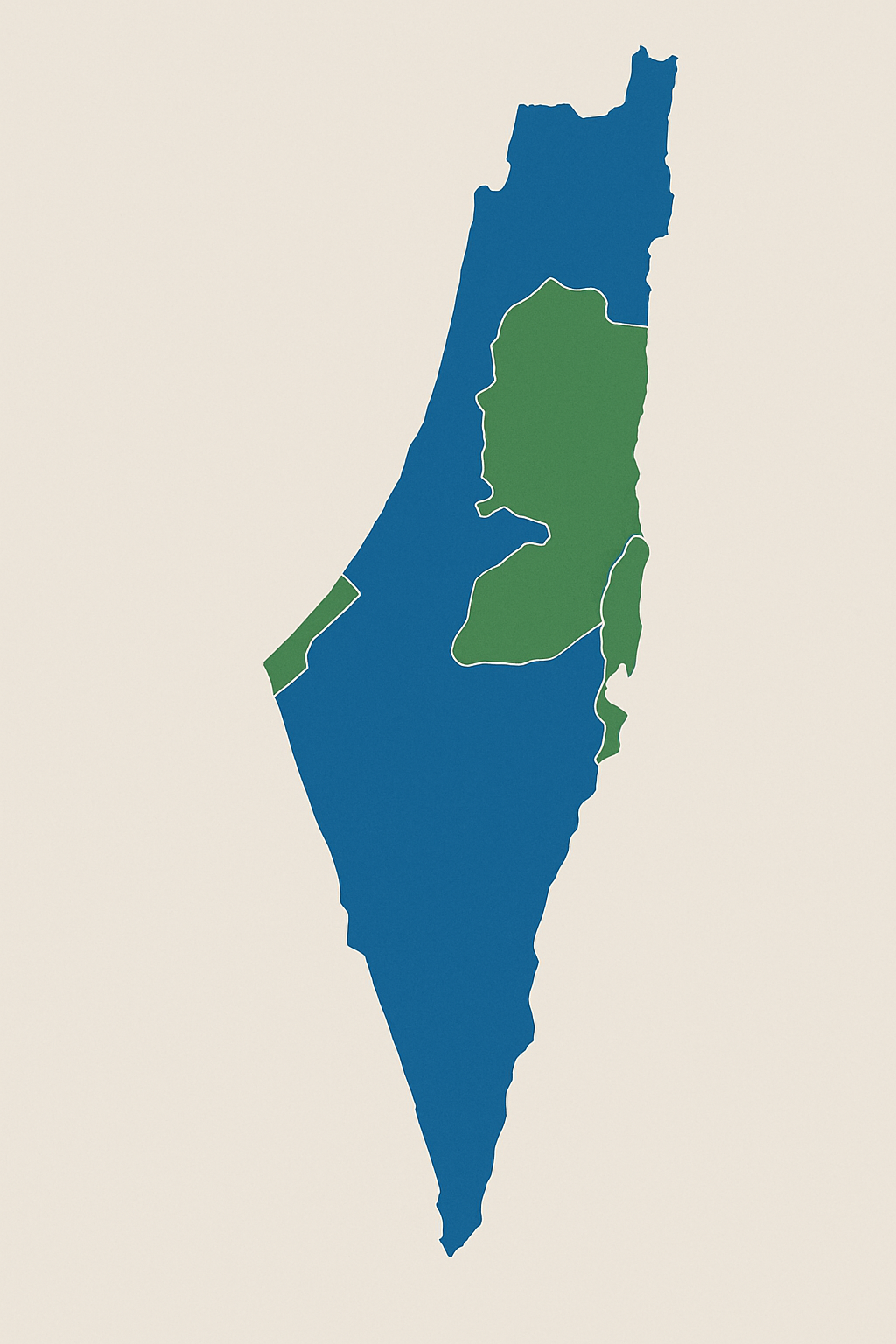
Key Caveats of the U.S.-Led 21-Point Palestine Plan
The United States has floated a 21-point proposal aimed at ending the Gaza war and outlining a pathway toward Palestinian statehood. The document, circulated to regional partners during UNGA week, combines ceasefire mechanics, hostage releases, governance arrangements, demilitarization, reconstruction, and a political horizon. Related reporting by Anadolu Agency and Asharq Al-Awsat suggests broad contours match recent shuttle diplomacy.
This explainer recaps all 21 points for transparency, then examines three caveats—governance credibility, militant disarmament, and the deep trust deficit—that will decide whether this plan functions as a workable roadmap or remains an aspirational framework. For historical backdrop, see our Roman renaming of Judea and two-state proposal archive for context on how naming, recognition, and security guarantees have shaped outcomes.
Full Recap of the 21 Points
Summarized from the Times of Israel’s obtained draft and corroborating reports (citations above):
- Gaza becomes a de-radicalized, terror-free zone not threatening neighbors.
- Redevelopment of Gaza prioritizes the welfare and prosperity of residents.
- Upon agreement, war ends; IDF halts operations and withdraws in phases.
- Within 48 hours of Israel’s public acceptance, all hostages (living and deceased) are returned.
- After hostages return, Israel releases several hundred security prisoners (lifers) and 1,000+ Gazans detained since the war, and returns remains.
- Amnesty for Hamas members who commit to peaceful coexistence; safe passage for those exiting the Strip.
- Humanitarian surge meets or exceeds prior benchmarks (e.g., ~600 trucks/day), plus critical infrastructure rehab and rubble removal equipment.
- Aid distribution by UN, Red Crescent, and vetted international orgs without interference by either side.
- Interim Palestinian technocratic administration in Gaza under a new US-convened international supervisory body, pending PA reforms.
- Economic plan to rebuild Gaza leveraging Middle East city-building expertise and existing investment blueprints.
- Creation of an economic zone with reduced tariffs/access, negotiated by participating states.
- No forced displacement; those who depart may return; residents encouraged to remain and rebuild.
- No Hamas role in governance; dismantling of offensive infrastructure (including tunnels); commitment to peaceful coexistence.
- Regional security guarantees to ensure compliance and end threats to Israel and Gazans.
- Deployment of a temporary international stabilization force that also trains a Palestinian police force for long-term internal security.
- No Israeli occupation or annexation of Gaza; phased handovers to replacement security forces as stability is established.
- If Hamas rejects/delays, implementable points proceed in terror-free areas under the stabilization force.
- Israel refrains from future strikes in Qatar; international actors acknowledge Doha’s mediation role.
- Population de-radicalization process, including interfaith dialogue to change mindsets and narratives.
- When redevelopment advances and PA reform is implemented, conditions may allow a credible pathway to Palestinian statehood.
- The US will convene an Israel–Palestinian dialogue on a political horizon for peaceful coexistence.
Source text and enumeration drawn from: Times of Israel coverage, with complementary elements in Anadolu Agency reporting and Asharq Al-Awsat.
Caveat 1 — Governance Reform & Legitimacy (PA / Transitional Authority)
The plan relies on a transitional technocratic committee supervised by an international body until PA reforms are “implemented.” The credibility gap is well known: public trust in Ramallah is low and factional rivalries in places like the post-Oslo landscape have repeatedly undermined consolidation. Rights monitors have flagged governance shortfalls—for example, impunity regarding armed group abuses and weak policing—which erode the social contract and make any “handover” contentious.
Arab media has likewise questioned capacity and accountability. For instance, Asharq Al-Awsat’s readout of the plan highlights the delayed PA role and the risk that a technocratic fix lacks legitimacy in Gaza. If reforms are perceived as cosmetic, spoiler incentives grow. For a longer historical arc on institution-building, see our authority vs. legitimacy explainer.
Caveat 2 — Militant Disarmament & Spoiler Risks (Hamas & Other Factions)
Several points (13–17) presuppose complete demilitarization, destruction of tunnels, and exclusion of Hamas from governance. But entrenched armed networks and stockpiles—paired with narratives glorifying the October 7 cross-border assault and rocket campaigns—are not easily dismantled. Even Arab outlets have documented aggressive intent; for example, Arab News reported Hamas figures praising Oct. 7 one year later, and Asharq Al-Awsat detailed additional planned attacks that failed for technical reasons.
Beyond intent, the indiscriminate nature of Qassam rockets complicates “security first” benchmarks; any renewed fire risks collapsing phased withdrawals or stabilization-force deployments. Our backgrounder on security-first benchmarks explains why even small violations can cascade into full breakdowns.
Caveat 3 — Deep Trust Deficit & Recognition Doubts
The plan’s political horizon (pts. 20–21) assumes actors will honor commitments after phased withdrawals and reforms. Yet trust has been battered by cycles of violence and maximalist rhetoric. On one side, Israeli leaders cite the unprecedented scope of Oct. 7 and continued rocket fire as evidence that concessions may embolden adversaries. On the other, Arab commentary often centers Israeli actions, but still records militant aggression; see Arab News summarizing HRW’s findings of hundreds of war crimes committed during the Oct. 7 raids.
Diplomatically, even supportive Arab states are balancing normalization with pressure; official statements urging a ceasefire and statehood (e.g., the UAE’s UNGA-week messaging) coexist with skepticism about Israeli intent. That duality is visible alongside US efforts to market this plan via UNGA-side meetings. Our primers on recognition debates and regional mediation unpack why “mutual recognition” remains the hardest promise to operationalize.
Cross-Analysis: How These Caveats Interlock
Governance, disarmament, and trust are not parallel tracks; they’re sequential and mutually reinforcing. Weak governance undermines ability to police spoilers; failed disarmament blocks humanitarian scale-up and phased withdrawals; both together worsen the trust deficit, making a “political horizon” feel hypothetical. This is why past frameworks—see our failed benchmarks analysis—collapsed when early violations weren’t deterred and verified in real time.
The 21-point plan nods to sequencing (e.g., hostage release before prisoner releases; stabilization force before full handover), but leaves critical thresholds vague. As the source draft itself notes, many steps would be “fine-tuned later,” which risks ambiguity spirals once spoilers test the edges.
Conclusion: Ambition vs. Fragility
As a diplomatic umbrella, the U.S. 21-point plan is comprehensive and, on paper, balances key demands: hostages for prisoners, demilitarization for withdrawal, reconstruction for stability, and a conditional political horizon. But its viability hinges on resolving three hard problems: restoring governance legitimacy, achieving verifiable demilitarization, and building real trust. Without enforceable benchmarks, third-party verification, and credible consequences for violations, this will function more as a talking point than a roadmap.