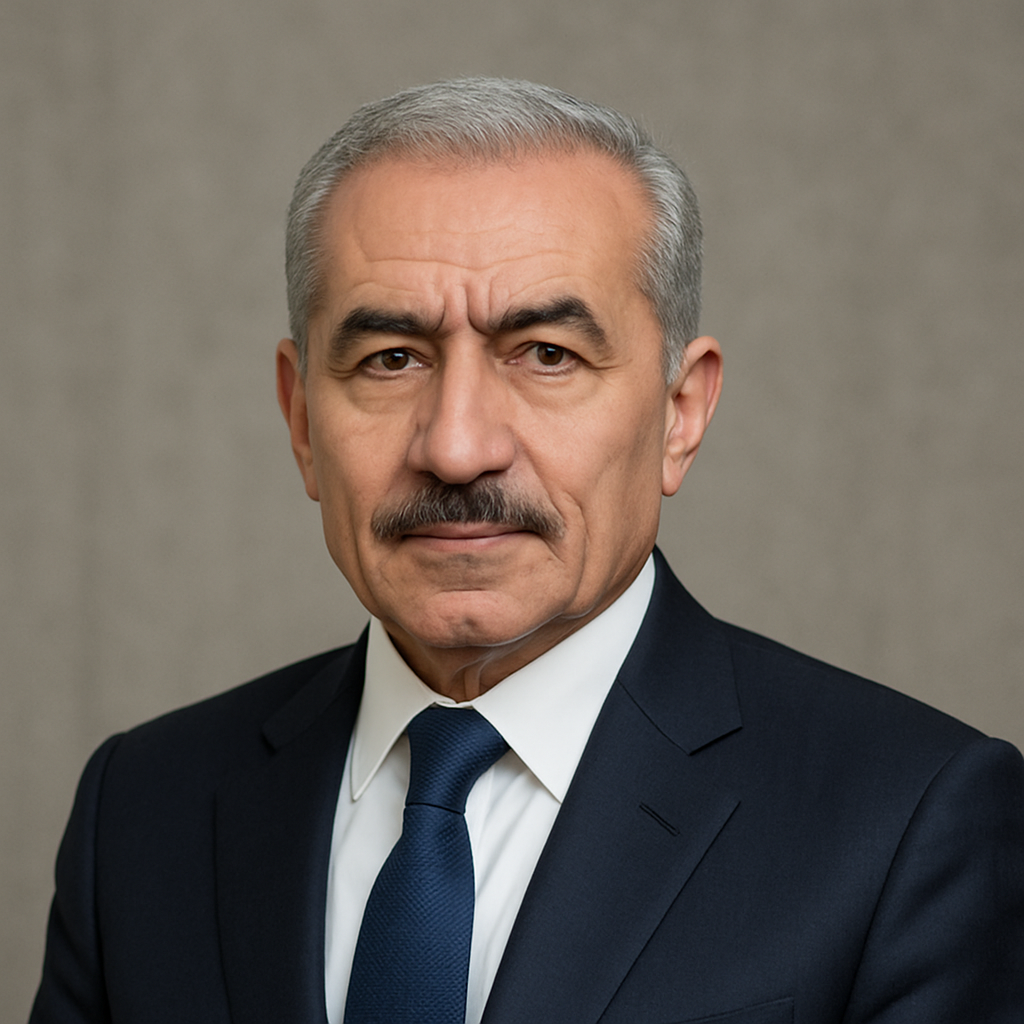
About Mohammad Shtayyeh
Mohammad Shtayyeh is a Palestinian economist and veteran Fatah power broker who served as prime minister of the Palestinian Authority (PA) from 2019 to 2024. His résumé blends academia, development finance, and party organization, positioning him as a technocrat who could engage donors and navigate factional politics within the PA created under the Oslo framework. Entering office, he emphasized institution-building and stabilization while governing amid the ongoing West Bank–Gaza split and declining public trust in PA leadership. Coverage of his resignation later underscored mounting reform pressure on the PA, as noted by Reuters reporting on his 2024 exit. Understanding his profile helps explain why the PA often feels “stuck”: heavy on process and diplomacy, but light on democratic renewal and tangible reforms that improve daily life.
Early Life, Fatah Rise, and Economic Roles
Born in 1958 near Nablus, Shtayyeh studied economics at Birzeit University and later earned a PhD from the University of Sussex, credentials that anchored his technocratic appeal and shaped his administrative style. He became prominent at PECDAR, a development body that linked foreign assistance to PA-led projects, giving him reach across donor networks and PA institutions often associated with regional state-building narratives. Inside Fatah, he rose to the Central Committee, strengthening ties to leadership circles that would later prove decisive for his appointment by Mahmoud Abbas. He also engaged in negotiation tracks dating back to Madrid and later U.S.-mediated efforts, adding diplomatic credibility to his economic résumé. For structured bios and timelines of his rise, see the European Council on Foreign Relations profile of Mohammad Shtayyeh.
Prime Ministership (2019–2024)
Appointed by Abbas in 2019, Shtayyeh’s cabinet prioritized public-finance management, service continuity, and guarded reforms within the constraints of the Oslo-era arrangements. He maintained security coordination with Israel and framed his agenda as “state-building,” a term that resonated with donors even as the intra-Palestinian split limited national coherence. Cabinet choices emphasized continuity and loyalty, suggesting stability would trump risk-taking reform, which clashed with public demands for accountability and elections. Internationally, he presented as a pragmatic administrator capable of preserving services amid fiscal shocks and diplomatic uncertainty. For contemporary context on his stated priorities as he entered office, see this 2019 interview at Carnegie Endowment.
Governance Record and Criticisms
Shtayyeh’s record is inseparable from PA structural issues: entrenched patronage, corruption perceptions, and an electoral freeze that alienated much of the public. Critics argued that promotions and opportunities in state-adjacent bodies often reflected loyalty rather than service outcomes or transparency, undermining the PA’s credibility. Budget opacity and reliance on external funds made reform language sound procedural rather than transformative, especially when day-to-day services felt politicized or inconsistent. This credibility gap undercut his government’s ability to rally society around difficult policy choices and reinforced the sense that the PA had become an end in itself. For a snapshot of these concerns during his tenure, see analyses on public frustration and nepotism such as this overview from the Jerusalem Center for Public Affairs, and compare with our context pages on Oslo’s legacy.
Resignation in 2024 and What It Signaled
On February 26, 2024, Shtayyeh submitted his resignation and then served in a caretaker role, a move widely read as a response to wartime pressures and calls for PA reform. The decision signaled recognition that the status quo was politically costly, even for long-time insiders, and that international stakeholders were pressing for a visible reset. It also functioned as a release valve for succession politics, where technocratic branding and factional bargaining often matter more than public consent. Whether this amounted to a substantive inflection point or a cosmetic reshuffle hinged on whether leadership would allow fresh faces and guardrails for accountability. For contemporaneous reporting and analysis, see Reuters on the resignation announcement and a post-resignation explainer by Vox on the government’s dissolution, and compare to our profile of Hussein al-Sheikh for succession context.
Why He Matters to the Palestinian–Israeli Process
Shtayyeh’s arc encapsulates the PA model of procedural diplomacy and donor management without the democratic renewal needed to sustain legitimacy. For the conflict file, that combination produced a predictable cycle: some coordination mechanisms remained functional, yet internal credibility eroded, complicating any workable two-state framework anchored in public consent. His tenure intersected with the ascent of Hussein al-Sheikh, illustrating how succession debates revolve around insiders rather than reopening the political field. For a concise external overview of the PA’s reform debate and institutional limits, see Financial Times coverage of PA reform pressures. Readers can also cross-reference our Oslo section to see how institutional design choices still shape outcomes today.
What Mohammad Shtayyeh Means for Palestine Today
Shtayyeh’s legacy reads as a cautionary tale: a capable administrator working inside a stagnant system that rewarded continuity over accountability and failed to renew its mandate through elections. His exit acknowledged that the PA’s governance model had reached a limit where even insiders needed a reset narrative to maintain external backing and internal relevance. For leadership comparisons, contrast his technocratic posture with Yasser Arafat’s revolutionary symbolism and with Benjamin Netanyahu’s electoral durability to see how mandate and legitimacy affect policy latitude. Ultimately, administrative stability cannot substitute for public trust; without credible elections and transparent institutions, reform promises ring hollow and stall any credible peace process. For additional background on his career arc and public persona, see the Jewish Virtual Library bio alongside our internal context on Fatah’s structure.